Welcome
The Oratory Church of Saint Boniface, a Roman Catholic parish in downtown Brooklyn, is a community with a rich history and a deep commitment to joyfully welcoming the challenge of growing as people of God. Though most of us live in the neighborhoods of Brooklyn, many also come from the broader metropolitan area, including Manhattan, Queens, Westchester, Long Island, and New Jersey. Our priests belong to the Community of the Oratory of St. Philip Neri. They are responsible for administering St. Boniface Church by contract with the Bishop of the Diocese of Brooklyn.
Our community is dedicated to celebrating the Gospel with reverence, affection, and openness toward all, ministering to the spiritual and material needs within and beyond our community, and engaging the moral questions of our day under the guidance of God's wisdom.
Music, reflective prayer, and study are integral parts of our liturgical life here at Saint Boniface. We are grateful and proud to have a dynamic and dedicated parish that gives of its time and talents to continually create a loving and joyous community.
If you live nearby or are just in the area, please stop by the beautiful church we have inherited and that our community has lovingly restored. Following the joyous example of Saint Philip Neri, founder of the Oratory, we proclaim that the foundation of our community is Jesus, the stone once rejected by the builders. Through Jesus, we become a spiritual home, peacemakers, a royal priesthood, and living stones.
This is a place of awe; this is God's house, the gate of heaven, and it shall be called the royal court of God. (Gen. 28:17)
In 1990 a timeworn church with a rich history and beautiful architecture hidden beneath layers of dirt and peeling paint sat in Downtown Brooklyn. Built by German immigrants in the 1870s, and now with dwindling parishioners and located amidst an economically depressed neighborhood, the Catholic parish of Saint Boniface faced a bleak future.
Our church has been and will always be made up of the community of people, the 'living stones'.
At the same time, the Brooklyn Oratory of Saint Philip Neri, priests and brothers of the Order of Saint Philip Neri, were searching for a permanent home.
The then-bishop of the Diocese of Brooklyn, Bishop Mugavero, envisioned an opportunity to wed this bride of a parish church to this suitor made up of dedicated servants. The Oratory Church of Saint Boniface soon was formed.
After years of extensive renewal - both of the charming neo-Gothic church structure and of the parish community - the Oratory Church of Saint Boniface soon became a home for a new generation.
And as the Oratorian priests and brothers took on as their primary ministry the parish of Saint Boniface, so have the parishioners - from those who travel a handful of blocks to church, to those who travel from neighboring boroughs and even states - now proudly call themselves Oratorians.
With the marking in 2004 of the 150th anniversary of the parish church, we are reminded that our church has been and will always be made up of the community of people, the 'living stones', dedicated to building up and continually renewing this parish. We are reminded of our true challenge: to dedicate ourselves to the love of God and neighbor.
"Like living stones let yourselves be built on Christ as a spiritual house, a holy priesthood." (I Peter 2:15)
In this way we lay the foundation for the next 150 years, and give future generations a heritage to celebrate.
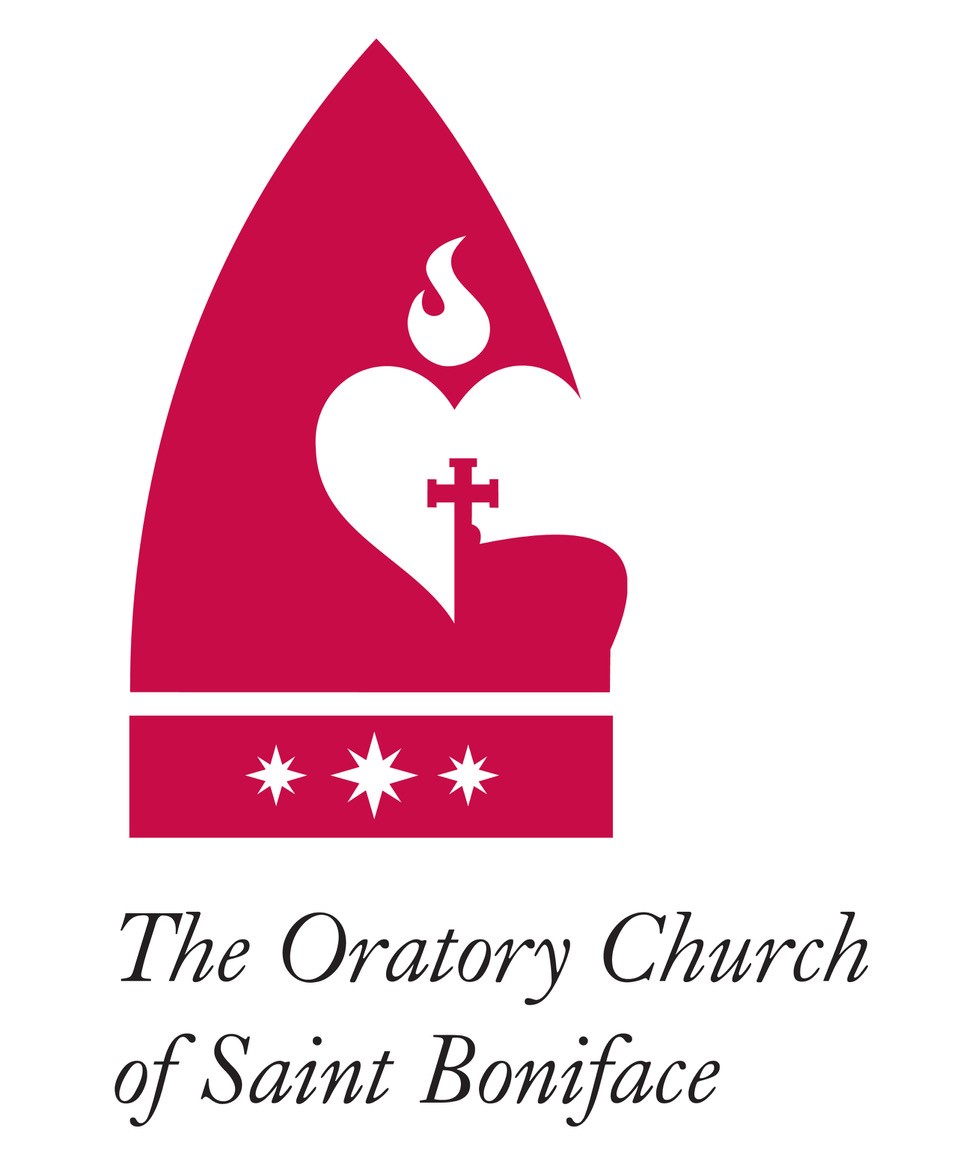
The logo that was created as part the 150th anniversary of the parish of St. Boniface reflects and describes the values and history of our dynamic community.
Integrating images of the guiding power of Saint Boniface and Saint Philip Neri, the centrality of the vibrant parish that is our community's heart, the joyous charism of the Oratorian community, and our deep commitment to and love of Brooklyn, the logo shows who we are, where we have come from, and the future we are making together.
The logo shows who we are, where we have come from, and the future we are making together.
Saint Boniface
The inverted red shield represents the martyred Bishop, St. Boniface, Apostle of the Germans. While its shape echoes the gothic arches that are a major element of the architecture of the 1872 Patrick Keely Church, it also forms the shape of a Bishop's hat or miter.
Saint Philip Neri
At the center of the logo is the image of the flaming heart, symbol of St. Philip Neri, the founder of the Oratory. The imagery derives from the seminal conversion experience of St. Philip: one night while he was at prayer, deep in the newly reopened catacombs in Rome, he felt the Holy Spirit descend through his mouth and lodge in his heart. For Philip, this experience was an affirmation of God's love for him and his burning love for God and others.
Saint Boniface Parish
The heart is open - open to Brooklyn and open to the future. At the center of the heart is the distinctive Jerusalem Cross, which echoes the cross that dominates the sanctuary of St. Boniface church. Christ is at the center of our journey, ad lucem per crucem - to the light through the cross.
Brooklyn
The crown intersects the lower corner of the flaming heart, representing the county of Kings in Brooklyn.
The Oratory
The lower band of the shield not only anchors the miter, but shows via the three stars, part of the Neri family coat of arms, that our mission is guided by the charism of Saint Philip, the patron Saint of Joy and the Apostle of Rome.
We, the community of the Oratory Church of St. Boniface, joyfully welcome the challenge to grow as people of God, baptized in Jesus Christ and within the Catholic and Apostolic faith.
We proclaim that the foundation of our community is Jesus, the stone once rejected by the builders.
• Awed by God's beauty, we celebrate reverent and time-honored liturgies.
• Nourished by God's love, we greet each other by name with affection and openness, welcoming strangers, guests, and all pilgrim people.
• Relying on God's truth, we seek to deepen our experience of the divine spirit through reflective prayer and study for ourselves, our youth and our children.
• Guided by God's wisdom, we search through revelation and experience to engage the moral questions of our day so as to inform our individual and corporate actions.
• Touched by God's healing, we endeavor to ease the human pains and predicaments we both cause and experience.
• Comforted by God's compassion, we minister to the spiritual and material needs within and beyond our community. We extend ourselves in the spirit of reconciliation, to forgive and to be forgiven.
• Challenged by God's justice, we foster the gifts, diversity and full participation of all within our society and our Church.
• Reflecting God's light, we cultivate the arts in their illumination of the human experience.
• Blessed by God's strength, we sustain our community through gifts of time, talent and treasure.
Following the joyous example of Saint Philip Neri, founder of the Oratory, we proclaim that the foundation of our community is Jesus, the stone once rejected by the builders. Through Jesus, we become a spiritual home, peacemakers, a royal priesthood, living stones.
The Church of Saint Boniface was built in 1871 for a parish founded in 1853 to serve the German speaking Catholics of the City of Brooklyn, The German origins of the parish were responsible for the choice of its patron; St, Boniface, missionary and martyr, is considered the Apostle of Germany and is that nation's patron saint. The statue over the door, as one enters the Church, depicts St. Boniface, vested (slightly anachronistically, for in the Eighth Century, vestments looked somewhat different) as a bishop. The axe and tree stump at his feet allude to an incident wherein he demonstrated the falseness of' pagan gods by cutting down without divine reprisal the oak tree on the summit of the Gudenberg at Geismar, which was honored as sacred to the god Donar. The book in his hand is the one he was reading as his murderers set upon him; scarred with sword cuts, it is still preserved at Fulda, where he is buried.
The identities of the scenes and saints in the windows of the side walls of the Church are hinted at through written texts and iconographic symbols. Beginning on the left side of the Church, the window closest to the altar depicts St. Boniface preaching to the German tribes. The harp and head-dress of the mournful gentleman in white identify him as a druid; he is presumably unhappy at the saint's success in converting his pagan countrymen. (As a druid is, of course, historically inaccurate for Germany, his presence here has sometimes caused the subject of this window to be identified as "St. Patrick".) The scroll in the hands of the angel above quotes Christ's commission to the apostles in Matthew 28:19, "Go forth into all the world and teach all peoples," The inscription below says that the window is the gift of the St. Boniface Society for the Sick and Assistance; such donors combine with the lack of trefoils to make the "St. Patrick" identification unlikely.
The following window depicts two virgin saints. On the right is St. Cecilia, an early Christian martyr who is the patron of music and musicians. She holds an organ, which is her usual attribute. On the left is the Italian noblewoman Chiara Offreducio known to us as St. Clare of Assisi* The first of' all Franciscan nuns (who called "Poor Clares" after her), she received the veil from the hands of St, Francis himself- She wears the habit of her order and holds the monstrance with which she turned aside a Saracen attack on her monastery of San Damiano in 1244. The angel above holds roses, which may symbolize several things, but are most commonly associated with the Blessed Virgin Mary.
The third window depicts Christ blessing the children, as described in the tenth chapter of the Gospel of Mark. The scroll of the angel above gives Christ's words on the occasion, "Let the little ones come to me." Between the two cherubim at the bottom of the window is a statement indicating that the window was a gift from Wilhelm Reisert.
The following window presents two royal German saints. On the right is St. Cunegund the Empress who holds the Cathedral of Bamberg which she founded On the left is her husband St. Henry, who may be better known to history as the Holy Roman Emperor, Henry IL He can be identified easily by the imperial German "crown of Charlemagne"' upon his head, as well as by the armorial bearings of the German emperors woven into his robe. The angel above holds an ostensorium with the Eucharist.
The last window on the left side of the Church shows the Blessed Virgin Mary giving the Rosary to St. Dominic. Our Lady's head is surrounded by twelve stars, to recall the "woman clothed with the sun" of the Apocalypse. St. Dominic is dressed in the habit of his order, and the attentive dog with the flaming torch beside him is his symbol. While St. Dominic's mother, Blessed Joan of Aza, was pregnant, she dreamed that "she bore a dog in her womb and that it broke away from her with a burning torch in its mouth wherewith it set the world aflame." It is worth noting that through a Latin pun, the Dominican Order (Dominicanes), founded by St. Dominic, became "Domini Canes" or "watchdogs of the Lord." The angel above holds a scroll which says, "Queen of the Holy Rosary, pray for us."
Across the nave, on the right side of the Church, the window closest to the doors depicts St. Margaret Mary Alacoque's vision of the Sacred Heart of Our Lord. Actually, a series of visions that extended from Christmastide 1673 to Corpus Christi week in 167, the revelations to St. Margaret Mary are the foundation for the popular Catholic devotion to our Lord's Sacred Heart as a symbol of His love for humanity. The angel's scroll at the top of the window says, "My sweet Heart of Jesus, grant that I may ever love Thee."
The next pair of saints are both Franciscan friars. On the right is St. Francis of Assisi himself, the "little poor man" of Assisi who founded the Friars Minor. He is shown with a crucifix to recall the one which spoke to him, and bears on his hands the marks of the stigmata he received on Holy Cross Day in 1224. On the left is St. Anthony of Padua, who, despite his name, was actually born in Lisbon and spent most of his life in his native Portugal. He is often depicted as he is here, holding the Christ Child in his arms — a scene based on a lovely but entirely legendary story that was first told some three hundred years after the saint died in 1231. The object held by the angel above is a shield bearing the coat of arms of the Franciscan order.
The central window on the right wall depicts the death of St. Joseph, the husband of the Blessed Virgin Mary and foster father of Christ. Since he was attended on his deathbed by both the Virgin Mary and our Lord Himself, St. Joseph has come to be regarded as the saint of a happy death. The scroll above says, "St. Joseph, pray for us; the note below notes that it was the gift of Joseph Ruppert. One may reasonably assume that the relation of the donor's Christian name to the subject of the window is not a coincidence,
The window immediately to the left honors two saintly matrons, perhaps as a sort of spiritual counterbalance to the two virgin saints across the Church. On the right is St. Elizabeth of Hungary, a Magyar princess who was the Landgravine (that is, wife of the Landgrave or ruling noble) of Thuringia in Germany. She was noted for her charity to the poor, which is the source of the legend depicted. According to the story, her husband felt her charity was excessive, and catching her with an apron full of alms for the poor demanded to see what she carried. When she opened the apron, the alms had miraculously turned to roses, and she avoided her husband's wrath. Actually, the story is quite unfair to the Landgrave Ludwig of history, who is recorded as looking favorably upon his wife's generosity. On the left is St. Anne, the mother of the Blessed Virgin Mary (and thus Christ's own grandmother) and patroness of housewives and women in labor. She is depicted in the way most common for her, namely, teaching the Virgin Marv to read. The roses held by the angel above represent purity and, as such, are emblems both of Our Lady and of St. Joseph.
The window closest to the altar depicts the martyrdom of St. Boniface in the year 754. While preparing for the confirmation of several new converts, St. Boniface and his companions were set upon by a hostile pagan band and slaughtered. The scroll above says that "'Christ is my Life, my Death, and my Gain." The restored panels below note the general restoration of the Church by the current congregation under the direction of the community of the Oratory. The faces of the cherubs in the new sections are portraits of donors' children.
The rose above the altar features the oldest stained glass in the Church, dating from about the same time the building was erected. The sides were produced about the beginning of the 20th Century. The general theme is the Passion (that is, Suffering) of Christ. On the cross in the center is the monogram "HIS," which (since what appears to be an "h" is actually a Greek "eta") forms the first three letters of the Holy Name of Jesus. Beginning at the apex of the triangle, one finds a pillar and scourges. Moving clockwise around the rose one finds swords; sponges reeds with a cup and a robe; dice, the placard for the cross, the ewer of water for Pilate's hands, and the face of Christ with a rope of a prisoner around his neck; a ladder and a hyssop plant; a hammer, pincers, and nails; and spears with the thorns. In the lower right corner, the "IHS" monogram of our Lord appears once more, while in the lower left is the "M" of the Virgin Mary.
There are fourteen circular portraits between the arches supporting the ceiling. Twelve of these apostles, the lack of attributes in each picture, makes the specific identification of all twelve a problem. Still, by relating the relative positions of those who can be identified immediately with those who cannot, a likely name for each can be established. From front to back on the left are St. Peter (with his key), St. John (beardless and rendering a cup of poisoned wine harmless with his blessing), St. James Major, St, James Minor (writing his epistle), St. Matthew (holding his gospel) and St. Simon (with a spear). The last portrait is St. Cecilia, the patroness of musicians; she is placed here because of the proximity to the choir loft. On the left side from front to back are St, Paul (with sword), St. Andrew (with his signature cross), St. Thomas, (the spear by which he was martyred): St. Philip, St. Bartholomew (with a scourge, an alternate way of representing his flaying); and St. Jude holding a book which represents his epistle. The last person pictured is King David, whose reputation as a singer, musician, and psalmist makes it appropriate to place him above the choir loft as well.
The parish of St. Boniface was founded in 1854 during a period of significant demographic transformation in what was then the City of Brooklyn. Over its more than 170 years of existence, the parish has been home to a series of distinct communities shaped by shifting economic, cultural, political, and ecclesiastical forces. The earliest of these was a predominantly German-speaking Catholic community. From the founding of the parish in 1854 through the later decades of the nineteenth century, German-speaking immigrants and their descendants formed the core of both the clergy and laity at St. Boniface.
To understand the founding of St. Boniface, it is necessary to situate it within the broader history of German immigration to New York. In the mid-nineteenth century, New York City was not yet the five-borough metropolis known today. Manhattan and a small portion of the western Bronx constituted "New York City," while Brooklyn—incorporated as a city in 1834—was rapidly expanding and, by the mid-1850s, had become the third largest city in the United States. Improved transportation, most notably the introduction of steam-powered ferries after 1818, facilitated a high degree of movement across the East River, linking the developing German communities of Manhattan and Brooklyn.
After the Irish, Germans formed the second-largest Catholic immigrant group in New York. Yet, German Catholics were a minority several times over: a minority within the city’s general population, a minority within New York’s Catholic population, and a minority within the broader German-American community itself. Approximately one-third of German immigrants in New York were Catholic, many arriving from Bavaria and the Rhineland—regions traditionally Catholic prior to German unification and well after, also. The remaining two-thirds included Lutherans, Reformed Protestants, Jews, socialists, and freethinkers, some of whom established consciously secular “congregations” and schools.
Economically, German immigrants tended to arrive with somewhat more capital and skilled training than many of their Irish counterparts. They established themselves in trades such as tailoring, shoemaking, cabinetmaking, baking, butchering, and particularly brewing. Successful brewers formed an economic elite within German-American society in both Manhattan and Brooklyn.
By mid-century, German immigrants in Manhattan formed a vibrant and densely populated enclave known as Kleindeutschland, or “Little Germany,” stretching from 14th Street to Division Street and from the Bowery to the East River. It was, at the time, one of the largest German-speaking urban concentrations in the world, surpassed only by Berlin and Vienna. In Brooklyn, German immigrants primarily settled in Bushwick, Williamsburg, and Greenpoint. By the end of the nineteenth century, German-Americans had become one of the most influential and prosperous ethnic groups in Brooklyn. German-born or German-trained architects, including Theobald Engelhardt, Rudolf Daus, Benjamin Dreisler, and William Ditmars, designed much of the industrial and residential landscape of these neighborhoods. And it was a German immigrant, J.A. Roebling, who designed the Brooklyn Bridge. German-American civic life flourished as well, supported by Turnvereine (athletic and cultural associations), Sängerbunde (choral societies), and beer gardens connected to the brewery industry. The Germania Club, founded in 1859 near Atlantic Avenue and Clinton Street and later housed in a grand clubhouse on Schermerhorn Street, reflects this period of cultural prominence.
The spiritual life of German Catholics developed more slowly. Although German-speaking Catholics had petitioned as early as 1808 for their own parish in New York, it was not until the arrival of Father Joseph Raffeiner in 1833 that sustained pastoral care began to take shape. Raffeiner, an Austrian physician-turned-priest, initially intended to travel west to minister to German Catholics in the Midwest. However, Bishop John Dubois persuaded him to remain in New York, where the German-speaking Catholic population was growing steadily. After several temporary worship spaces, Raffeiner secured property and oversaw the founding of St. Nicholas Church on East 2nd Street in 1836, the first German-speaking Catholic parish in the city. Following internal disputes there, he established Most Holy Trinity in Williamsburg in 1841, which came to be known as the “German Cathedral” of Brooklyn. During the following two decades, Raffeiner played a central role in the establishment of at least eight additional German parishes, including St. Boniface.
By the early 1850s, German-speaking Catholics had begun to settle in what is now the downtown Brooklyn and Brooklyn Heights area. To serve this population, a group of lay leaders approached Father Raffeiner in 1853 with plans to establish a parish closer to their homes. Their efforts coincided with the creation of the Diocese of Brooklyn by Pope Pius IX on July 29, 1853, and the appointment of John Loughlin as its first bishop. One of Bishop Loughlin’s earliest acts was to support the founding of this new German parish. A former Episcopal church at the corner of Willoughby and Bridge Streets was purchased for what was considered a modest sum. On January 29, 1854, Bishop Loughlin dedicated the church under the patronage of St. Boniface, the eighth-century missionary-bishop and apostle to the German peoples—a patronage well suited to the cultural and spiritual identity of its founders.
From 1854 through the early 1870s, the parish of St. Boniface served as a focal point of worship, community formation, cultural continuity, and immigrant adaptation for German Catholics in Brooklyn. The construction and dedication of the present church building in 1872 marked both the growth and consolidation of this early community. The legacy of these founding families, clergy, and lay leaders remained integral to the identity of St. Boniface and to the development of Catholic life in Brooklyn throughout the nineteenth century and into the early twentieth. Yet, with the onset of the First World War, a wave of anti-German sentiment swept across the United States, fueled by wartime nationalism and suspicions of disloyalty. German Americans were increasingly pressured to downplay their heritage: German-language newspapers closed, schools dropped the teaching of German, clubs and parishes quietly rebranded themselves, and many long-standing cultural traditions were set aside. At St. Boniface, this shift was felt sharply and rather abruptly, as German-language worship and devotional practices were curtailed; and compounded by broader residential patterns that saw many German American families moving out of Downtown Brooklyn, the parish’s distinctly German character began to fade rapidly in the years following the war.